

Elephants are among the most intriguing creatures on Earth. They are huge in terms of size, but gentle in their manner of living. Emotional, intelligent and socially connected elephants have attracted our attention for many centuries. They have appeared in classic stories as well as modern documentaries and as cultural icons across the globe. However, beyond their stunning appearance, they are a complex and emotional animal that has some surprising resemblances to humans. These are our top 10 interesting facts about elephants that are explained in depth.
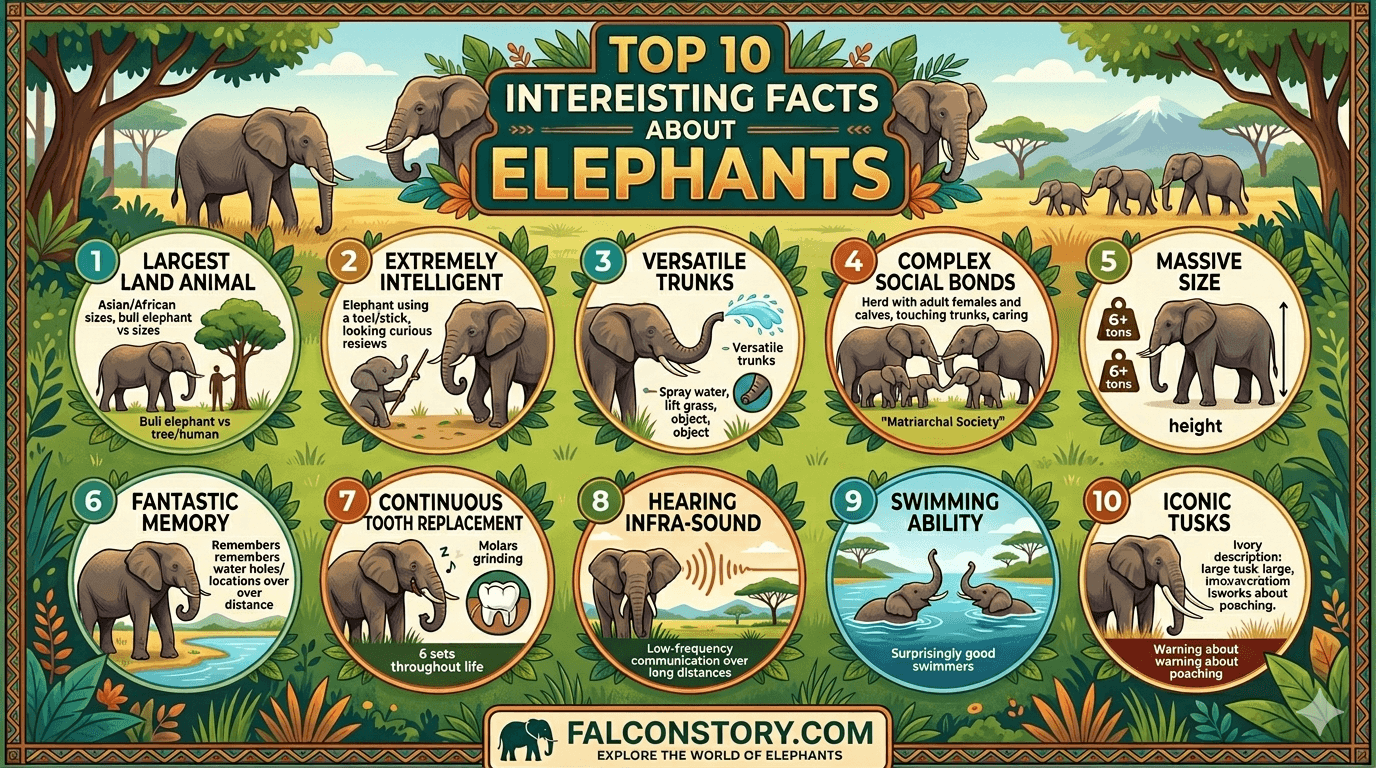
Top 10 Interesting Facts About Elephants
1. Elephants are among the largest land animal on Earth
Elephants are known as being the largest animal to ever live on the land. A mature elephant could weigh more than a thousand pounds and can stand higher than many vehicles. Even though they are huge, the elephants can move smoothly and comfortably. Their bodies are constructed to withstand a lot of weight, with long legs that function as pillars, and feet that spread the pressure evenly across the floor.
2. Elephants are extraordinarily smart
The elephant is among the most intelligent creatures in the world. They are able to solve problems as well as see themselves in mirrors and keep track of people and places for years. Their brains are huge and complex, with particular emphasis on those that are linked to emotions and memory. This helps them to stay alive in the wilderness by storing rivers, water sources as well as social interactions.
3. Elephants have a remarkable memory
The saying “elephants never forget” exists because of an explanation. Elephants are able to remember places as well as dangers and elephants, even after prolonged periods of time. This is especially important in droughts, since older elephants tend to remember distant sources of water that younger elephants have not seen.
4. The elephant trunks of the forest are extremely strong and precise
The trunk of an elephant is considered to be among the most fascinating body parts of animals. It is home to many muscles but has there are no bones. Elephants make use of their trunks to take in and smell, drink water and lift large objects and even pick up small objects such as seeds or grass. A trunk which could dismantle a tree could also gently stroke a baby calves.
5. Elephants are emotionally sensitive animals.
Elephants are able to experience emotions like happiness, sadness, fear and sorrow. They mourn their deceased, usually being close to the body, while gently touching bone by using their trunks. Elephants can also comfort the grieving members of their community by touching them and remaining close to them, showing compassion that is rarely observed outside of humans.
6. Elephants reside in strong families
Elephants are very social animals and are part of close-knit families that are led by a mature female, called the matriarch. The matriarch leads the group, makes choices and also protects the younger members. Family bonds last for a lifetime and elephants are dependent on the support of their social network.
7. Elephants communicate in a variety of ways.
Elephants communicate with the body language, sound even vibrating. Certain calls are so insignificant that we cannot hear their sounds. They can travel over long distances on the ground which allows the elephants to talk with their herds of animals far from them. This type of communication can help keep them connected across vast regions.
8. Elephants can have a long gestation
Pregnancies for elephants last around 22 months, which makes them the longest land animal. This lengthy period of development ensures that baby elephants are born with brains that are well-developed. The newborn elephants depend on their mothers as well as other members of their families and the entire herd can help in their protection and care.
9. Elephants play a crucial function in their ecosystems
Elephants are commonly referred to as “ecosystem engineers.” As they move, they rip down trees and dig for water and spread seeds across their dung. These actions affect the landscape, provide water sources for other animals and encourage the growth of plants. Without elephants, the ecosystems would undergo a dramatic change.
10. Elephants live a long time.
Elephants live long lives usually between 60 and 70 years wild. Their lengthy lives permit wisdom and knowledge to be passed on over generations. Elephants who are older play an essential part in guiding herds of elephants and ensure their survival in tough times.
Final Thoughts
Elephants are beyond just big animals. They are also feelers, thinkers as well as leaders and guardians of their surroundings. Their brains are superior to other primates. Their emotions reveal deep bonds with their fellow animals, and their contribution to nature is incomparable. Knowing about elephants helps us comprehend not only the importance of animals, but equally how important empathy, memory and co-operation within the world of nature. The protection of elephants is one of the planet’s most fascinating living creatures.