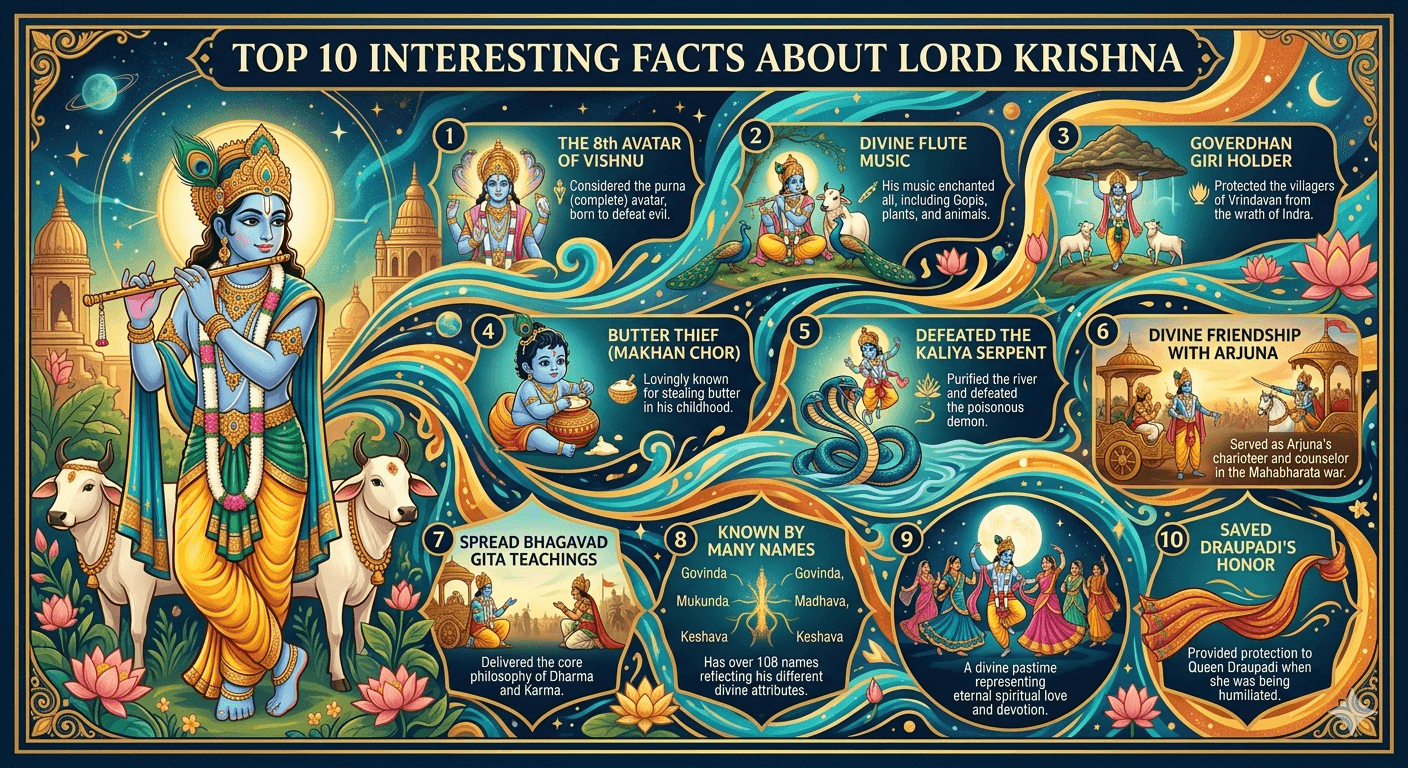


Lord Krishna is among the most adored and complicated characters in Indian tradition. He is worshiped by the gods, revered as a king. He is admired for his philosophic skills and adored for his playful nature. A few figures from the world of mythology play multiple roles simultaneously and make them seem natural.
Krishna’s stories aren’t just about battles or miracles. They discuss the everyday life the way it is: loss and love as well as duty and doubt Joy and struggles. His presence is timeless. Ten facts that explore the different aspects that Lord Krishna and explain why he’s still important and is still relevant today.
Top 10 Interesting Facts About Lord Krishna
1. Lord Krishna Is the Eighth Avatar of Vishnu
Krishna was believed to represent the 8th avatar of Lord Vishnu created to bring balance back when injustice was prevalent in the world. His birth occurred within Mathura during the time of the dictator Kansa.
In contrast to many gods who appear mature Krishna’s story unfolds from the age of infancy until adulthood. His long and varied life path lets people connect to him at all stages: child or friend, guide and even ruler.
2. His Birth Was Surrounded by Danger
Krishna is a child born into a prison. Kansa was warned that the eighth son of Devaki would be the one to destroy him. The moment Krishna was born his father Vasudeva carried Krishna across the flood-prone Yamuna River to safety.
The dramatic start sets the stage for the rest of Krishna’s life. From the beginning the danger was there but he fought back — not through strength alone, but rather through timing as well as intelligence and destiny.
3. Krishna Was Known for His Childhood Mischief
As a young child living in Gokul or Vrindavan, Krishna was famous for taking butter from pots, smashing them and even teasing the villagers. The stories may sound jolly but they are actually full of more significance.
They demonstrate a God who is a personable god. Krishna is a person who laughs, has mistakes, and loves life. This is the reason why children as well as adults alike feel a sense of belonging to him. He is not distant or afraid.
4. He Lifted Govardhan Hill, Not a Weapon
One of his most famous actions is to lift Govardhan Hill to protect villagers from the rains that were sent by Indra. It’s interesting that he didn’t use weapons. He fought with protection, not destruction.
The tale teaches us that the real power lies in responsibleness and compassion and not in the ego. Krishna did not take on Indra to be the king, he merely encouraged him to be humble.
5. Radha Represents Krishna’s Spiritual Love
Krishna’s relationship to Radha is not typical romantic love. It is a symbol of the pure love and connection between souls. In a myriad of religions, Radha represents the human soul, whereas Krishna symbolizes the divine.
The love tales of their characters are full of sadness, longing and joy, as well as separation and reunion. These emotions are very human. This is why poets as well as saints keep coming back to Radha-Krishna and repeatedly.
6. Krishna Rarely Fought Directly in the Mahabharata
In the Mahabharata conflict, Krishna did not lift weapons. Instead, he was Arjuna’s charioteer. The choice of this role is crucial.
Krishna provides guidance, counsel and provides support, but lets people make their own decisions. He doesn’t impede the individual’s freedom. Even if he knows what will happen, he lets the events to unfold by the actions of humans.
7. The Bhagavad Gita Came From a Battlefield
The Bhagavad Gita was uttered by Krishna in the middle of a battle and not in a tranquil temple or forest. Arjuna was frightened, confused and morally divided.
Krishna was not able to provide easy solutions. He talked about duty, actions without attachment, dedication, or self-knowledge. The message was simple: life is complicated and absolving yourself of accountability isn’t the answer.
8. Krishna Used Strategy More Than Strength
Krishna is often referred to as the master of strategy. His actions — both in his childhood and in the Mahabharata–were based upon more intelligence than force.
He knew people well including their pride, fears and weaknesses. Instead of conquering opponents, he would often surpass them. This is what makes Krishna an example of wisdom at work and not blind power.
9. He Lived Like a King, Yet Remained Detached
Krishna Ruled Dwarka by the title of King and was surrounded by wealth, family and the power of his family and wealth. But the scriptures repeatedly demonstrate that he was emotionally distant from the possessions.
When Dwarka was demolished, Krishna accepted it calmly. His life has taught him that being involved with the world is good, but the attachment to it can result in suffering.
10. Krishna’s Death Was Quiet, Not Glorious
Unlike many heroes, Krishna did not die in battle. He was struck accidentally by an arrow from a hunter’s gun while contemplating.
The ending of this story highlights that even the most divine incarnations are subject to the rules of the universe. Krishna’s departure was easy and quiet, confirming one of his most fundamental beliefs that nothing in the physical world is everlasting.
Conclusion
Lord Krishna is not understood through a single story or part. He is a jolly yet serious and calming yet firm. He is human and yet divine. This is the reason why him timeless.
Krishna doesn’t want people to get rid of their lives. He encourages for them to live life fully with the awareness as well as responsibility and freedom. This is the reason why, even thousands of decades later, the tales remain real intimate, personal, and alive.