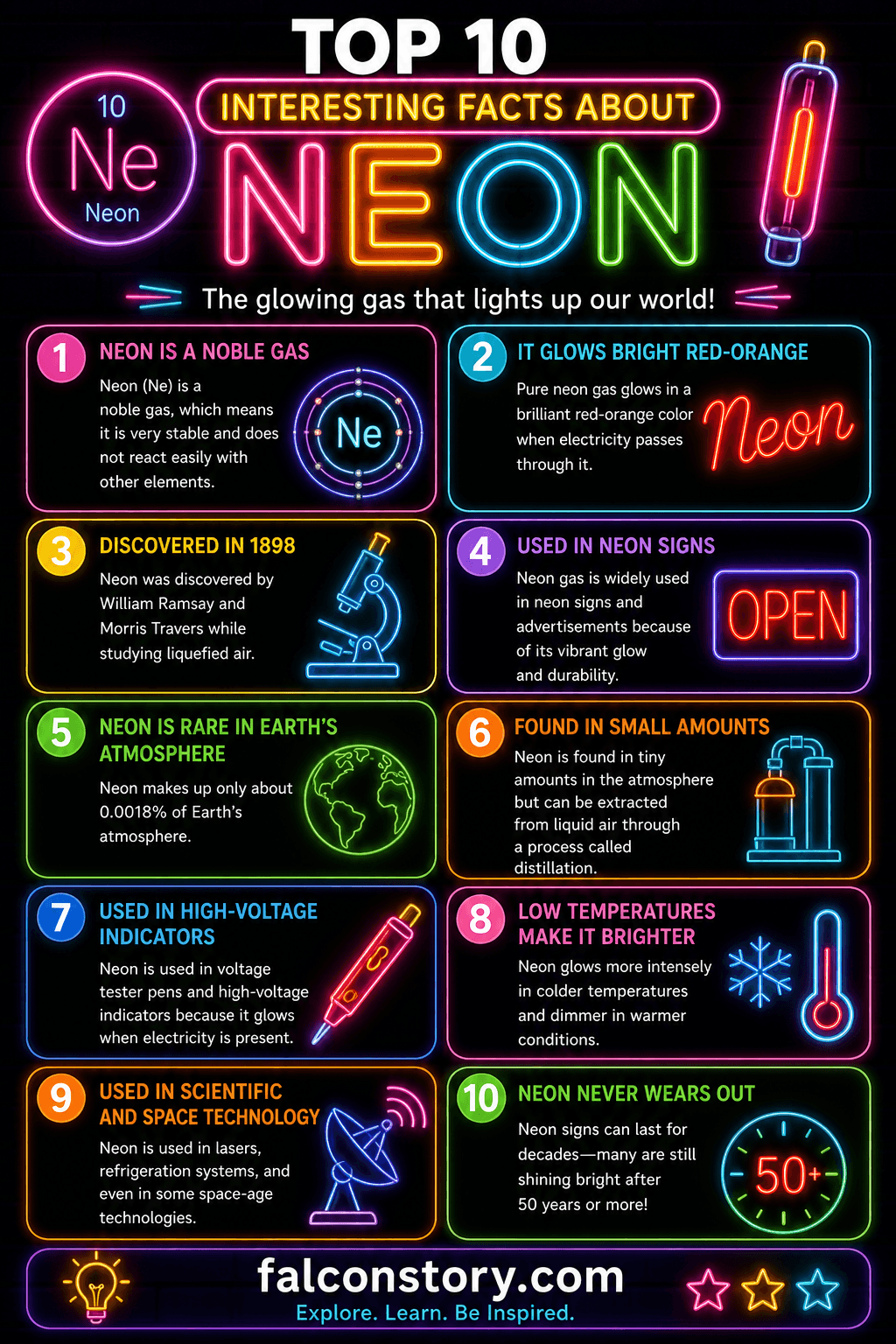


Neon is among those things that everybody has seen, but not many people really think about. Its luminous light has transformed cities, signs, cinema aesthetics, and even nightlife for more than hundred years. In the moment people hear about neon lights, they typically think of bright neon signs that illuminate dark streets or bustling markets. However, behind the soft glow lies an intriguing tale of science, rare and a surprising utility.
Neon isn’t as noisy or threatening like fire. It isn’t a rusty, explosive, or be a quick reacted. It prefers to remain still and unnoticed. But, when electricity flows through it, it glows in a way that none other element can. The contrast between calm behavior and dazzling beauty is the reason why neon is so intriguing.
Here below are some of the most fascinating facts concerning neon which are explained in detail and demonstrating how this element is superior to what it appears.
1. Neon Belongs to the Noble Gas Family
Neon is a member of a set of elements that are known by the name noble gas. They are referred to as “noble” because they rarely interact to other elements. Neon is particularly stable and is not able to make compounds.
The lack of reactivity makes neon extremely secure. It won’t explode, burn or corrode the substances surrounding it. This is the reason why neon can be encased in glass tubes for years without altering its properties. Its calming chemical nature is among its best advantages.
2. Neon Is Surprisingly Rare on Earth
While neon is prevalent throughout the universe, it’s very uncommon on Earth. It is only a small fraction of the Earth’s atmosphere is made up of neon. Because it’s light, a lot of it went into space long before.
The neon we have nowadays is not extracted from the earth. It is extracted through the process of separating air into various gases. This makes it valuable and often difficult to source in times of shortages, particularly in the global market.
3. Neon Was Discovered Relatively Late
Neon is a discovery made by scientists in 1898 testing liquefied gas. As they separated various gases, they discovered one that produced a brilliant luminescence when powered by electricity.
The element was given the name “neon,” meaning “new,” since it was a new discovery in the time. The interesting thing is that the element existed for a long time in the air, however humans weren’t aware of it until the advancement of science allowed them to identify it.
4. Neon Has Its Own Natural Glow Color
Pure neon will always be glowing the same color, a warm red-orange when electricity flows through it. This hue is exclusive to neon and cannot be replicated naturally by other gases.
Many people think that all bright signs are made of neon, however this isn’t the case. Purple, blue, green and pink lights typically originate from different gases or coatings. Only the traditional red-orange glow can be described as the true neon light.
5. Neon Lights Are Highly Energy Efficient
Neon bulbs use less power than traditional incandescent bulbs. After the gas has been ignited the light continues to glow with a very low amount of energy.
This was the reason neon signs became extremely popular in the beginning of the 20th century. Businesses could have signs illuminated all night long without massive electric bills. Even in the present, neon is an effective lighting solution for certain applications.
6. Neon Lights Do Not Heat Up Much
Contrary to the old filament bulbs neon lights don’t depend on heat to create light. The light is generated by gas atoms that are energized and not from the burning of or heat generated by metal.
As a result, neon tubes stay cool even after several hours. This means they are safer in many scenarios and decreases the possibility of damage or fire.
7. Neon Is Used in More Than Just Signs
While neon is well-known for its use in signboards, it can also be used in numerous other applications. It is employed in voltage indicators as well as lasers, vacuum tubes as well as scientific instruments.
Its glowing properties make it easy to identify electric flow that’s why it’s employed in monitoring and testing equipment. The reliability of Neon makes it useful for both industry and science.
8. Neon Is Created Inside Stars
Neon isn’t just an Earth element. It is made within stars via nuclear reactions. Space is where neon is among the elements that are more commonly used.
It means that every neon light on Earth is made up of atoms formed in stars a long time ago. In a poetic way the neon lights originate of stardust, linking cities to the universe.
9. Neon Is Completely Invisible Without Electricity
In its original state, neon is without color, scent, and it has no taste. It is possible to breathe in air that contains neon and not even be aware of it.
When electricity is used to excite neon atoms, does the famous glow begin to appear. In the absence of energy, neon is invisibly and unnoticed which proves that light isn’t always concerned with color. It’s all about movement at the scale of the atom.
10. Neon Can Last for Decades Without Degrading
The neon gas doesn’t wear out. A properly constructed neon sign can last for 30 to 50 years or more, if the glass is in good condition.
Most neon lights are damaged due to broken tubes or electrical problems but not because the gas ceases functioning. Neon itself is able to last almost all the time, making it among the longest-lasting lighting components ever utilized.
Final Thought
Neon is an excellent illustration of how something that is seemingly simple can become amazing. It doesn’t react, it doesn’t age, nor does it require attention until electricity is flowing through it. It then glows with stunning beauty. The rarest on Earth but often seen in space, unnoticed but unforgettable, neon resides in a quiet spot at the intersection between science and the arts.