

Republic Day is one of the most significant national days in India However, a lot of people think of it as an event marked by parades and flag-raising. In real life, Republic Day represents a moment in the history of India when the nation stopped being governed by borrowed laws and started to govern itself by the constitution of its own citizens.
Every year, on the 26th of January, Republic Day is not only about patriotism and celebrations. It’s about the rights, responsibilities, and democracy and the belief that power is ultimately the property of the people. Behind the marching troops and colorful tableaux, are tales about struggle, vision and the careful building of a nation.
These here are Top 10 Facts About India’s Republic Day which are clearly explained and in detail.
10 Facts About India’s Republic Day
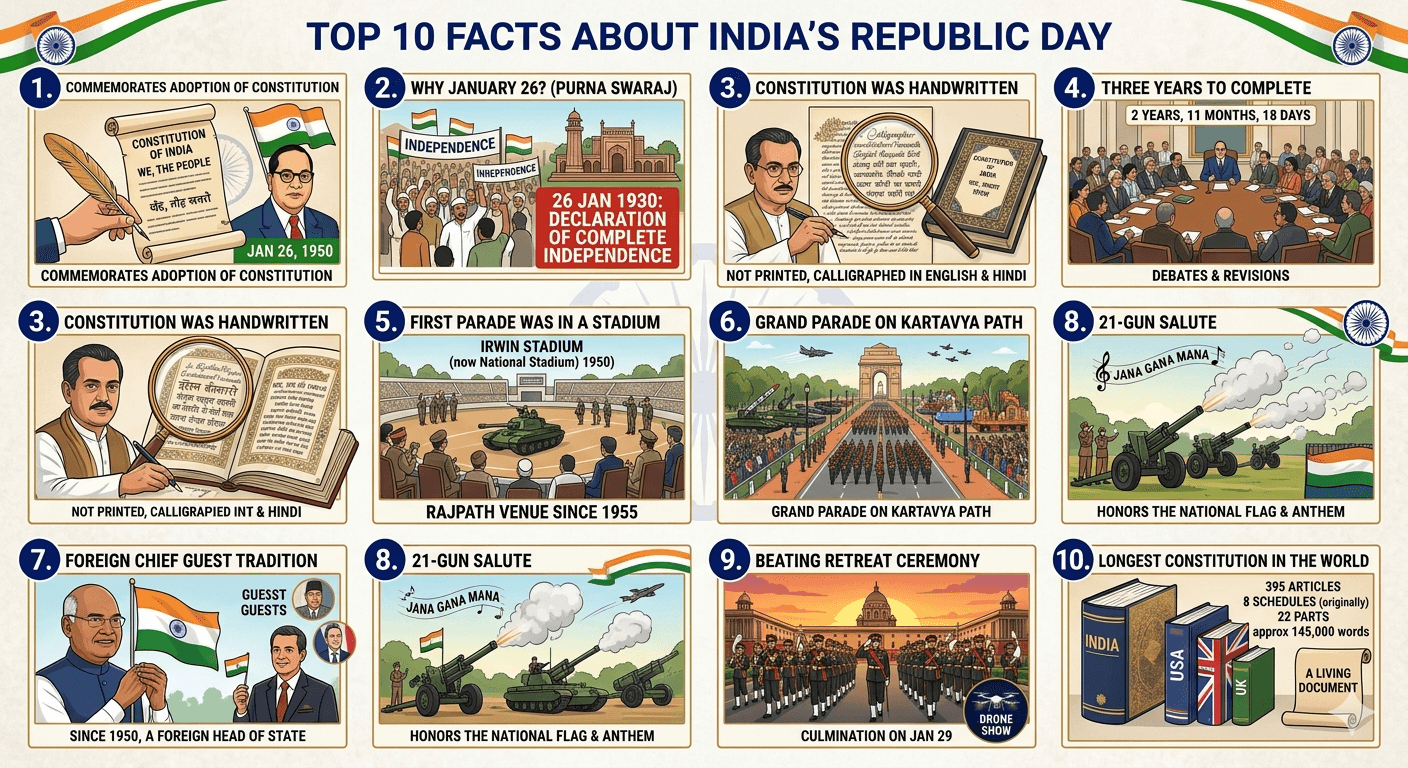
1. Republic Day Marks the Birth of India’s Constitution
Republic Day is celebrated on 26 January since it was the day that when the Indian Constitution came into effect in 1950..
While India became independent from British rule in 1947, the country remained to adhere to the laws enacted during British rule for over two years. On January 26, 1950 India was declared a republic. which means that the country was guided by its constitution and not by any other outside authority or monarchy. This was the moment that marked India’s transition from colony to a democratic sovereign nation.
2. India Became a Republic, Not Just an Independent Nation
Independence Day and Republic Day are often misunderstood, but they are two distinct concepts.
Independence Day marks freedom from British rule. Republic Day marks the adoption of a system under which the president is elected and not inherited. This change meant that India took over with the British monarch as the head of state by electing the President of India elected in accordance with the Constitution. This change gave significance to India’s freedom.
3. The Date 26 January Was Chosen for a Special Reason
The date of 26 January was not picked randomly. In 1930, on this day in 1930, the Indian National Congress declared Purna Swaraj which means complete independence from British rule.
While independence did not come until 1947, the Indian leaders chose to declare it on the 26th of January to commemorate the historic declaration. In adopting the Constitution on the same day, India linked its legal freedom to its previous political commitment.
4. The Indian Constitution Is One of the Longest in the World
The Constitution of India is one of the longest constitutions written in the world.
This covers everything, from basic rights and responsibilities to the structure of government as well as elections, judiciary as well as emergency power. It was designed to manage a country with vast diversity–languages, religions, cultures, and traditions. The precise nature of the Constitution shows the effort taken to safeguard unity and respect for the diversity.
5. It Took Nearly Three Years to Write the Constitution
It was the Constituent Assembly took almost three years to finalize it. Indian Constitution.
The process of writing involved lengthy discussions, debates and disagreements. Every clause was scrutinized carefully. The goal was not speed but balancing order and freedom rights and duties as well as harmony and a regional identity. This slow, thoughtful process was instrumental in establishing a solid base for the nation.
6. The Republic Day Parade Is a Symbol of National Unity
The Republic Day parade in New Delhi is among the largest national celebrations anywhere in the world.
It showcases India’s strength in the military as well as its cultural diversity and technological advancement. Tableaux from diverse states emphasize local customs, traditions and achievements. The parade is more than an opportunity to show off, but also an opportunity to remind us that different cultures come together to form one nation.
7. The President of India Takes the Salute
In celebration of Republic Day, the President of India is saluted during the parade in his capacity as the head of state in the constitution of the country.
This is the role that allows civilian control over army, a fundamental democratic principle. The presence of the president demonstrates that the military is a servant of to serve the Constitution and the citizens and not a particular person or political party.
8. A Foreign Leader Is Invited as Chief Guest
One distinctive characteristic that is unique to Republic Day is inviting a foreign head of state to be the main guest.
This custom reflects India’s values in diplomatic relations and global relations. The guest symbolizes friendship with the world, co-operation, and respect. In the past, leaders from a variety of major countries have been present at the celebration which has made Republic Day an event of international significance.
9. Republic Day Celebrations Happen Across the Country
While the parade’s main event is held at New Delhi, Republic Day is celebrated across every district, state and in every village across India.
Offices, schools, colleges and communities host flag-raising, cultural events and speeches. These celebrations in the community remind people that democracy does not belong to the capitalist class, but is available to all.
10. Republic Day Is About Citizens, Not Rulers
In the end, Republic Day is about the power of ordinary citizens.
The Constitution protects rights like equality and freedom of speech and justice. It also imposes obligations to citizens, reminding them that democracy only works when people behave responsibly. Republic Day is a reminder that India is not controlled by kings or colonizers. It is run by its citizens, by laws.
Final Thought
Republic Day is not just an annual date on the calendar or an event on TV. It demonstrates India’s dedication to democracy, equality and independence. It is the moment that India took a stand against the power of force as well as the debate over force and unification over division.
Every year on the 26th of January The celebration is not solely about the nation but of the notion that millions of voices are able to unite in a single Constitution. This is the essence of what defines India the republic it is.