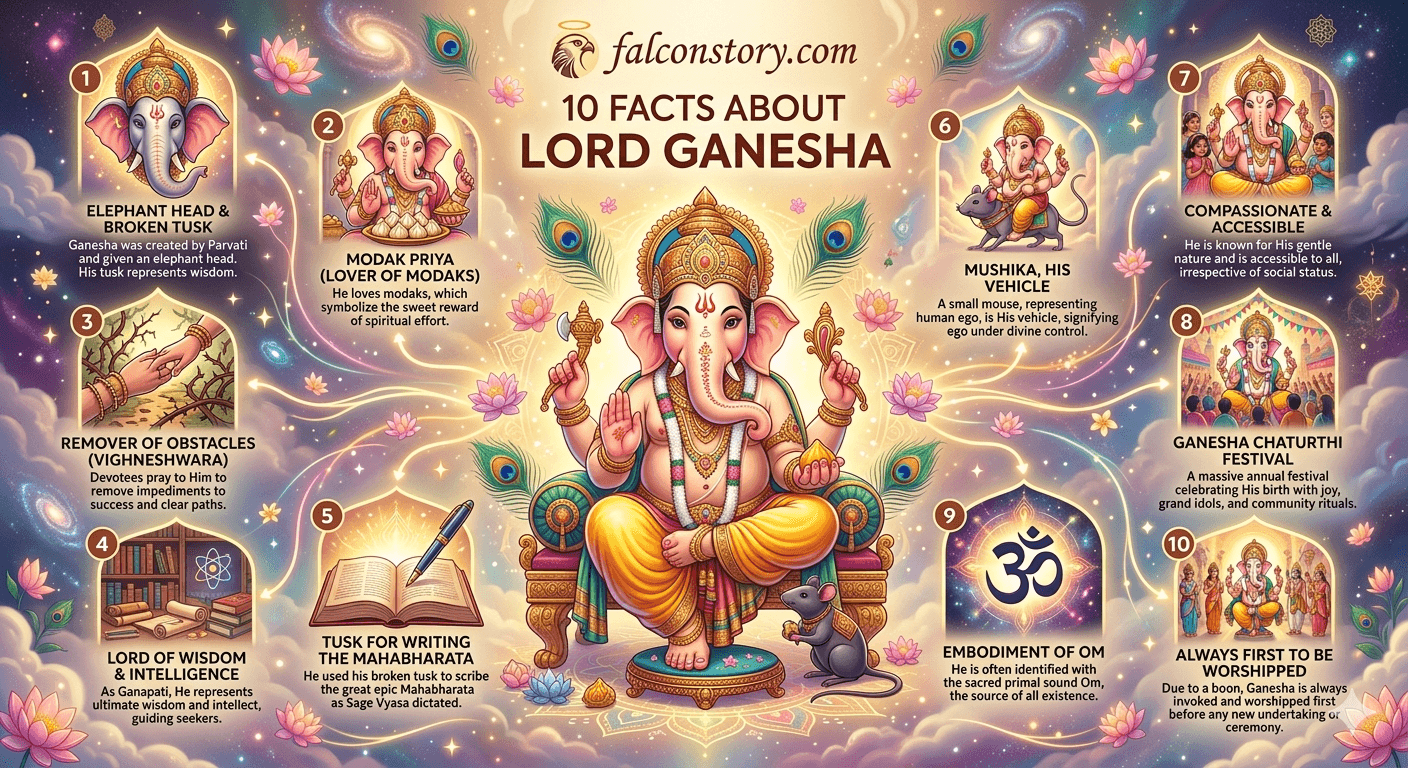


Lord Ganesha is among the most well-known and beloved characters within Indian culture. His image is everywhere: temples and homes, as well as books and celebrations, even when you begin a significant work. For some this will be the very first God they are taught about. For others, he’s the symbol of wisdom good beginnings, prosperity, and security.
However, Ganesha is more than a god with a friendly elephant head. Every aspect of his body is a symbol of significance. Every story that is connected to him will reveal something about the human condition and intelligence, as well as discipline and even balance. Through the ages the stories have been retold time over and over again. They are not as myths, but rather as guidelines for the way of life.
Let’s examine Top 10 interesting Fact about Lord Ganesha that most people have only from the surface but don’t really understand.
Top 10 Facts About Lord Ganesha
1. Ganesha Is Worshipped Before All Other Gods
In Hindu tradition there is no significant ceremony or work of auspicious significance is completed without first praising Ganesha. This isn’t merely an edict; it also reflects Ganesha’s role as the removal of obstacles. It’s simple: clear the path prior to walking it.
Spiritually, it is also about calming the mind prior to starting any task that is important. When they remember Ganesha prior to anything else, we are able to symbolically take away ego, confusion and a sense of fear. That’s why he’s known as Vighnaharta–the person who takes away obstacles.
2. His Elephant Head Represents Intelligence and Memory
The elephant is known for its quick memory, patience and a lot of strength. The head of Ganesha symbolizes wisdom that is peaceful but not aggressive. It encourages people to think before they act and also to remember lessons learned of the past.
The head’s size also hints at the importance of knowing over physical strength. Ganesha is not a warrior just like the other gods. His strength lies in his understanding and a strategy, not violence.
3. His Broken Tusk Has a Deep Meaning
One of Ganesha’s tusks has been broken. This isn’t a problem, but rather an opportunity to learn. According to the legend, Ganesha broke his own tusk in order to continue writing the Mahabharata when his pen stopped working.
The tusk broken represents sacrifice to achieve a greater goal. It shows us that we have to give up the smallest thing to accomplish something bigger. It also represents accepting imperfections as a normal part of life.
4. Ganesha’s Big Ears Teach an Important Habit
Ganesha’s big ears aren’t only a design element. They are a symbol of being attentive and talking less. It is a sign of wisdom when someone pays attention and absorbs knowledge.
In the midst of a crowded world, this wisdom is even more pertinent. Ganesha reminds us that understanding is a result of concentration, not through the constant roar of talking.
5. His Small Eyes Symbolize Focus
While Ganesha’s ears are huge His eyes are tiny. This is an intentional choice. It shows that although we need to listen with a wide swath and pay attention to the details, we should be focused on.
The constant distractions can weaken the mind. The eyes of Ganesha remind devotees to remain focused on their goal and to stay away from distractions and noise.
6. The Mouse as His Vehicle Is Not a Joke
The mouse, Ganesha’s ride is often a source of confusion for people. What makes such a powerful god ride tiny animals? This is the answer in the symbolism.
The mouse symbolizes the desire and lack of restlessness. Ganesha riding a mouse demonstrates the ability to control desires. It shows that the mind should guide impulses and rather than be controlled by impulses. Even the tiniest of impulses can create chaos if they are not controlled.
7. Ganesha is Linked to Both the Wealth and Knowledge
Ganesha is a symbol of wisdom, however he’s also associated to prosperity. This combo is not common. It implies that wealth comes from education and rational thinking.
In contrast to luck that is blind Ganesha’s blessings are obtained through discipline, education and ethical actions. This is the reason why students, writers and businesspeople revere him.
8. Ganesh Chaturthi Was Once a Quiet Festival
Nowadays, Ganesh Chaturthi is grand and loud, however, it was once an occasion that was largely celebrated in the homes of families. The popularity of public celebrations grew during the Indian freedom movement as a means of uniting people.
The festival reminds people that dedication is not only a personal thing but also a collective one. The real meaning isn’t in the size or volume but in the sincerity and reflection.
9. Ganesha Represents Balance in Life
Ganesha’s appearance is an ideal balance of opposites – small and big weighty and light the strength and softness. He is a sweet lover, but is disciplined. He is fun, yet knowledgeable.
This equilibrium teaches us that life is not a race to the extremes. It is a matter of an equilibrium between pleasure and accountability.
10. Ganesha Is a Symbol, Not Just a Story
In addition to mythological stories, Ganesha symbolizes the perfect human mind: serene as well as thoughtful, disciplined and compassionate. His tales aren’t meant to be taken literally.
They can be used to understand the nature of life, choices, and the consequences. This is why Ganesha continues to be relevant across generations and cultures.
Final Thought
Lord Ganesha isn’t just a god of worship, he is recognized slowly and in depth. His symbolism may seem straightforward however, his significance is multifaceted and eternal. Each feature conveys an important message, and each story gives direction.
When people bow before Ganesha when they bow to Ganesha, they are not only seeking blessings. They remind them to be clear make wise choices, act with integrity and to move forward without anxiety.